




Centennial Botanical Conservatory Undergoes Renovation and Expansion!
by Scott A. Sumner
Guy Walter is the City of Thunder Bay Landscape Architect and Supervisor of Landscape Architecture and Horticulture. He has been involved in saving the Centennial Botanical Conservatory from demolition. I asked him some questions about how the project is progressing.
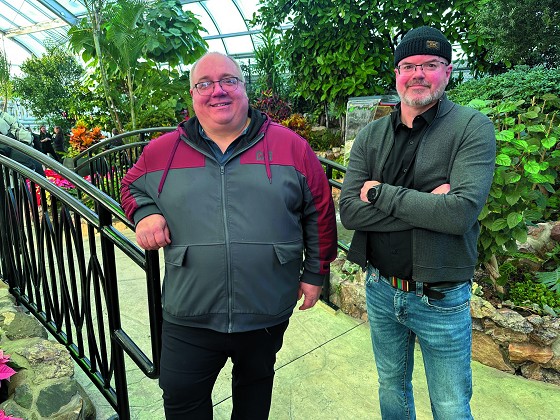
Above: Kelvin Jankowski, Manager Capital Facilities Construction and Guy Walter, Landscape Architect City of Thunder Bay
How did you get involved in the Centennial Botanical Conservatory?
“ Since I took this position at the end of 2020, this was the first project on my desk- to see how we could save it. It was going to be demolished, but the community saved it from demolition and it was going to be patched up. We came up with a different strategy. Not just patching and replacing greenhouses, but turning it into more of a community hub for production, research development and supply operation for all the city. “ This includes all the needs for the city parks, but also the needs for storm water management and native natural plants. We brought in many other partnerships like the LRCA, Lakehead University, Fort William First Nation- partnering to restore a lot of landscapes around the region.”
How was the scope of the project changed?
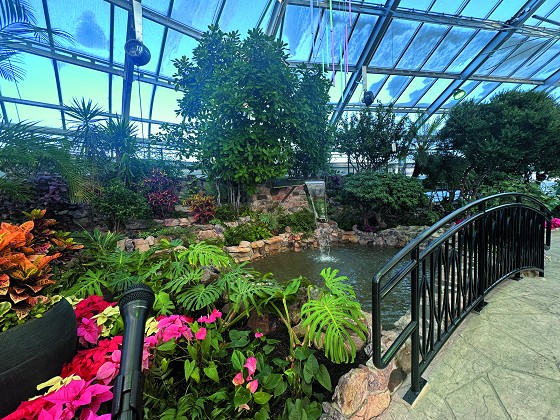
“ We have a dual purpose which allowed us to build out a facility that could support this work. We expanded the original strategy to just replace and patch up, to building proper facilities for production, a work shop and space for the public to host classes. We now have a stand alone facility that is connected to our tropical green house. The overall footprint was expanded by 2000 square feet and the green houses are larger that the old ones we demolished. The tropical wing gained some height.”
“ We had a drop off area added, some parking and a few trees. We needed to rebuild that area with outdoor venuses to host events, community gardens, a dementia garden and working with the LCRA on our aquatic garden. The Horticulture Society, master gardeners are working with us as well. The community outreach has expanded with the Faculty of Education at Lakehead University and the school boards growing their curriculum.”
What was the cost of this project?
“ In the actual project, the budget came in a little higher, but things in Phase 1 came in under at $4.2 million. We also rebuilt infrastructure both power for further expansion and our water supply and kept them within the budget although it wasn't originally planned.”
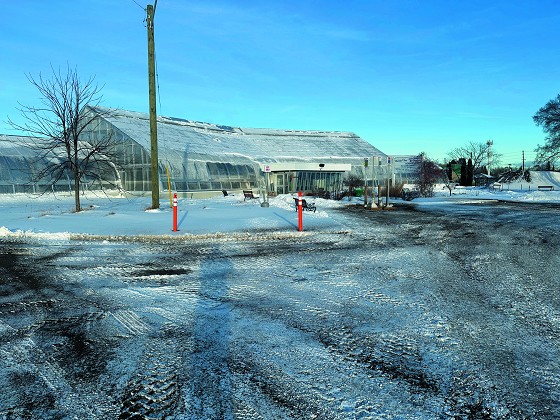
“ Phase 2 was $7.2 million and we are on budget and on schedule. We added some of the phase 3 work into Phase 2 so that is why we have an arrival area with rough grading so we could have this opening today. The remaining work in Phase 3 will be done in 2026 with funding secured somewhere around $1.2 million.”
How did the project affect existing plants at the Centennial Botanical Conservatory?
“ We had good luck in saving some of the plants that have been around for a long time. They were hoarded and heated. The contractor and sub trades did a great job, not many people have done any sort of work like this, not just here in Thunder Bay- but anywhere. It was a big learning curve for everyone, but we all worked together and protected the majority of the large specimens. Also we grew a number of species in case we did lose some, but had smaller versions to replace them.”
How do you feel about the project and results so far?
“ I think the project is great. I love the facility, everyone is very proud of it. Everybody that works here is very proud of it as well. I think the community wanted us to get the doors open, which has happened, and you can see everything. We are keeping the place free because it is City Park.You can come and hang out in the tropics!”
Are you working on any other City of Thunder Bay projects?
“ The Waterfront Festival area is a major project. It will start construction early 2026, that's Phase 1-the Camelot parking area next to the Tai Chi Gardens with new parking lot and playground. In the early part of the summer we will tender Phase 2 and 3 to do the whole grounds in 26 to the end of 28.”
“ I worked with the Red River Road development with Engineering with planter installation. Also the streetscapes bringing in more substantial,we call it green infrastructre, into our urban street.” “ The roundabout in North wood was the first I worked on and we produced the plants for the medicine wheel as well as the new roundabout at Cumberland.”
“ The new Pool 6 waterfront trail with a wetland park is in partnership with LRCA and RAP with property at the site for the cruise ships coming.”
“ Also there are the Victoriaville and Simpson Street areas and the Chippewa Park Carousel which we designed. Its very busy for us at the city.”
Centennial Botanical Conservatory-Complex Construction!
I asked Peter Belluz and his team at M Builds who were the general contractor some questions about the Conservatory project!
This is a very unique project with I am sure had some complexity to the work. How did your work begin and what were the steps in the process?
“Work began with the demolition of the existing East and West greenhouse wings, including the removal of their glazing and steel structures. This initial phase, carried out in the spring and summer of 2024, required meticulous sequencing to ensure the surrounding plant life remained unharmed. Once these structures were removed, new foundations, steel framing, and acrylic glazing systems were constructed throughout the summer and fall. Due to supply shortages and sourcing of the specialized glazing system for the new exterior of the Conservatory, deliveries and scheduling were critical and had to be managed with entire construction team. M Builds was able to expedite completion of the new east wing prior to freeze up.”
“Interior finishing and mechanical work were scheduled through late 2024 into spring 2025, at which point attention shifted to the Main Tropical greenhouse. Because this central space housed some of the most sensitive and mature plant specimens, the removal of its existing glazing could only occur during the warmer summer months of 2025. New acrylic glazing and its associated structural supports were completed during that same season, followed by intricate overhead interior work in late summer and fall.”
I was told your team had to do some special work to maintain some plants through the winter season with heating, etc?
“ The Conservatory Phase 2 project presented a rare combination of construction complexity, environmental sensitivity, and seasonal constraints that demanded careful planning and exceptional coordination. From the outset, the central challenge revolved around completing major demolition and reconstruction work while protecting the Conservatory's extensive collection of mature tropical and desert plant species—living elements highly vulnerable to thermal shock, physical disturbance, and environmental fluctuations. M Builds and their team of subcontractors worked together with the City of Thunder Bay Parks Department representatives in a truly collaborative fashion, developing the strategy for the execution of the project early in the project. “I want to say right off how great the folks at the Parks Department of the City of Thunder Bay have been to work with” said Peter Belluz, President of M Builds in Northwestern Ontario. “Undertaking this type of project in an operational facility, over a 20 month time frame, with freezing winter conditions and excessively hot summer conditions, all the while protecting the high value plants and trees in the facility, was truly a remarkable task. Everyone pulled together to ensure that all decisions were made in the best interest of the facility, and this resulted in a very successful project”.
“Throughout the process, the team implemented innovative protection strategies to safeguard the plant collection. In the West wing, desert species—including cacti and arid climate plants—were enclosed in an insulated hoarding system equipped with temporary heating to maintain a stable microclimate during demolition and construction activity. Similar thermal-protection measures were deployed in the Main Tropical greenhouse in fall 2024, ensuring plant health until a new boiler and hydronic heating system could be installed and brought online. Accessing work areas within the densely planted Main Tropical greenhouse also presented unique logistical challenges. Limited maneuvering space and the height of the interior volume required a combination of narrow, highly agile lifts and strategically placed scaffolding.”
“These systems were arranged to avoid contact with large trees, dense planting beds, and other vegetation while still allowing crews to safely reach overhead work zones.”
How did the sub trades perform on this project which may have had some unique aspects to it?
“ The project's success was strengthened by highly collaborative sub-trades who brought deep experience and adaptability to a site where conventional construction methods were often impractical. Many members of the team had previously worked together during Phase 1—the New Production Greenhouse project—which provided a shared foundation of knowledge. Even so, Phase 2 introduced new complexities related to protecting established mature plant life while navigating the regional constraints of a short construction season. Each sub-trade contributed to real time problem solving as conditions changed, making the project a uniquely engaging experience for all involved.
“From the very outset of the project, all of the subcontractors we worked with were enthusiastic to ensure the project progressed in the best possible manner, and were eager to provide their expertise” said Anthony Yozipovic, Project Manager for M Builds. “Many of the construction methodologies we used were planned pre-construction, and we based our tender on the ideas developed very early in the project. Once on-site, the actual site conditions became clear and modifications to the general plan were required, and our subcontractors were instrumental in working with us and the other trades on site to ensure the overall success of the project. We want to thank all of our subtrades for their valued input”.
There is another stage left to go on this project Phase 3. What will those steps involve?
“ Looking ahead, Phase 3 will focus on exterior site improvements, including grading, stormwater retention, landscaping, and upgrades to vehicular access and parking areas, scheduled to commence in spring 2026. Reflecting on the progress to date, the project team is extremely proud of the outcomes achieved through the combined efforts of dedicated subcontractors, suppliers, consultants, and City staff. The project's success is a testament to the coordinated commitment of all partners working together to deliver a highly complex and environmentally sensitive redevelopment.”